



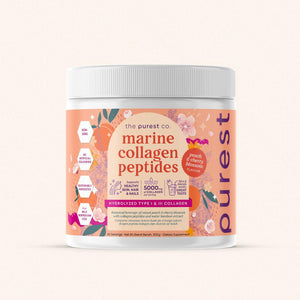

















There's no proven best time to take collagen. In the trials that found skin benefits, people simply took it once a day, every day, for 8 to 12 weeks. So the best time to take collagen is the time you'll actually remember, whether that's morning, with a meal or after a workout. Consistency matters far more than the clock.
Key takeaways
- We found no study showing that morning, night or empty-stomach timing changes collagen's results for skin.
- Skin trials used a daily dose for 8 to 12 weeks. Skipping days matters more than the hour.
- Your body needs vitamin C to build collagen, so pairing the two makes sense.
- Constipation wasn't reported in the major trials, but drink enough water, especially in the heat.
- Marine collagen comes from fish. If you have a fish allergy, ask your doctor before taking it.
Is there a best time to take collagen?
Not one that research supports. Hydrolysed collagen (collagen pre-broken into small pieces called peptides) is digested into peptides and amino acids that pass into your blood. In one trial, those amino acids peaked in the blood about an hour after a dose of gelatin, a close relative of collagen supplements (Shaw et al., 2017).
For skin, what matters is what happens over weeks, not hours. A 2021 meta-analysis pooled 19 randomised trials with 1,125 participants, 95% of them women, and found better skin hydration, elasticity and wrinkles with hydrolysed collagen than with placebo. None of them tested timing; they simply asked people to take it daily. For the full picture, including where the evidence is weaker, see our guide to collagen benefits for skin.
Morning, night or with meals: does it change anything?
On an empty stomach in the morning
A popular idea is that collagen absorbs better with nothing else in your stomach. There's no good evidence for it. If it makes you queasy, have it with breakfast. Morning's real advantage is habit: it's easy to pair with your first glass of water.
With meals
Taking collagen with food is fine. It also adds to your daily protein, but it shouldn't replace eggs, fish, chicken, tofu or beans. Our guide to how much protein women need explains why.
At night
The case for night-time collagen comes from glycine, an amino acid that sits at every third position along collagen's chains, making it about a third of its building blocks (Shoulders and Raines, 2009). In small studies, 3 g of glycine before bed improved sleep quality in people who slept poorly (Yamadera et al., 2007). But that was pure glycine, and a typical collagen serving contains less than 3 g of it. Collagen for sleep hasn't been tested, so treat night-time dosing as a preference.
Before exercise
In a small 2017 trial, eight healthy men took 5 g or 15 g of vitamin C-enriched gelatin, or a placebo, then skipped rope for six minutes an hour later. With 15 g, a blood marker of collagen production doubled (Shaw et al., 2017). It was a tiny study of gelatin that measured a marker, not injuries, and it tells us nothing about skin.
How much collagen should you take per day?
Collagen isn't an essential nutrient, so there's no official daily target. Skin trials have used a range of doses. In one well-known German study, 2.5 g and 5 g a day both improved skin elasticity in 69 women aged 35 to 55 after eight weeks, and the higher dose did no better than the lower one (Proksch et al., 2014). Follow the serving on your product label rather than doubling up.
Should you take collagen with vitamin C?
It's a sensible pairing. Your body needs vitamin C to make collagen (NIH Office of Dietary Supplements), so falling short on it can limit how much you build. Guava, calamansi, papaya and mango are easy local sources. We go deeper in collagen and vitamin C: why they're paired.
Does collagen cause constipation?
It isn't a common problem in the research. The 2021 meta-analysis reported no adverse effects in any of its 19 trials, and the German skin trial noted no side effects over eight weeks. If you notice a change after starting, check the basics first:
- Water: mix collagen into a full glass and keep drinking. You lose more fluid through sweat in Philippine heat.
- Fibre: collagen has none. If it replaces a merienda of fruit or vegetables, your fibre intake drops.
- Your doctor: see one if constipation persists, or comes with pain, bleeding or unexplained weight loss.
Who should be careful with collagen?
Marine collagen comes from fish, and collagen is a recognised fish allergen. A study of more than 100 fish-allergic people found that about 1 in 5 were sensitised to fish collagen (Kalic et al., 2020, via AAAAI). If you have a fish allergy, don't take marine collagen without your allergist's advice. Our guide to marine, bovine and plant collagen compares the sources.
Also check with your doctor first if you're pregnant or breastfeeding, have kidney disease or have been told to limit protein, or take medicines with strict timing instructions.
How to make collagen a daily habit

- Pick one anchor moment. Breakfast, merienda or after a workout.
- Keep it where you'll see it. By the kettle, on your desk or in your gym bag.
- Mix it with a full glass of water.
- Give it 8 to 12 weeks. That's how long skin trials ran. Here's how long collagen takes to work.
A simple daily option from The Purest Co
If you want a format that's easy to keep up, Collagen Glow Berries is a berry-flavoured drink: one sachet stirred into water, done in about a minute. Each sachet has 6,000mg Replenwell® Marine Collagen Di-Peptides, 250mg Vitamin C, 100mg Bilberry Extract and 50mg Glutathione, so the vitamin C pairing is built in. It contains fish, so it isn't suitable if you have a fish allergy. Take it at whatever time of day you'll remember.
Frequently asked questions
Is it better to take collagen in the morning or at night?
Neither has been shown to work better. Collagen trials asked people to take it once a day without a set time, and we found no study comparing morning and night doses for skin. Choose the time you'll stick to every day; that matters more.
Can I take collagen on an empty stomach?
Yes, if it agrees with you. There's no good evidence that an empty stomach improves absorption, because your gut breaks hydrolysed collagen into small peptides and amino acids either way. If it makes you queasy, take it with food instead.
How much collagen should I take a day?
Collagen has no official daily target, so follow your product label. Skin trials have used a range of doses. In one German study, 2.5 g and 5 g a day both improved skin elasticity in women aged 35 to 55 after eight weeks, and the higher dose did no better.
Does collagen cause constipation?
It wasn't reported as a side effect in the 19 trials pooled in a 2021 meta-analysis. If you notice a change, drink more water, especially in hot weather, and keep eating fibre-rich fruit, vegetables and beans. See a doctor if constipation persists or comes with pain or bleeding.
How long does collagen take to work?
Plan on two to three months of daily use. The trials that found better skin hydration and elasticity mostly ran 8 to 12 weeks, though some measured changes as early as four weeks. Results are modest and vary between people.
Sources: de Miranda et al., International Journal of Dermatology, 2021 · Proksch et al., Skin Pharmacology and Physiology, 2014 · Shaw et al., American Journal of Clinical Nutrition, 2017 · Yamadera et al., Sleep and Biological Rhythms, 2007 · Kalic et al., JACI: In Practice, 2020 (AAAAI summary) · Shoulders and Raines, Annual Review of Biochemistry, 2009 · NIH Office of Dietary Supplements, Vitamin C Fact Sheet for Health Professionals


